Nigerian Buyer Orders 8 Used Wheel Loaders and a 100 TPH Fixed Crushing Plant
By FairTradeMachinery Editorial Team | Reviewed by Sam Hou, Senior Equipment Inspector | Published 26 October 2026 | Updated 26 October 2026 | 8 min read
Quick answer. In October 2026, a Nigerian contractor, Mr. Omar, ordered 8 used small wheel loaders and 1 fixed crushing plant rated at 100 tonnes per hour from FairTradeMachinery. He had contacted several Chinese suppliers before ordering and said FairTradeMachinery was the only one that offered side-by-side equipment alternatives plus a written after-sales commitment covering installation guidance, spare parts shipped from China, and referral to Chinese engineers based in Nigeria.
Order at a glance
Item | Detail |
|---|---|
Buyer | Mr. Omar, construction contractor, Nigeria |
Order | 8 used small wheel loaders + 1 fixed (stationary) crushing plant |
Rated capacity | 100 tonnes per hour (TPH) |
Original requirement | Mobile crushing plant — changed to a fixed configuration |
Supplier | FairTradeMachinery, used construction machinery exporter, China |
Deciding factors | Depth of comparable alternatives; written after-sales package |
Support included | Remote commissioning guidance, spare parts from China, local engineer referral |
Order date | October 2026 |
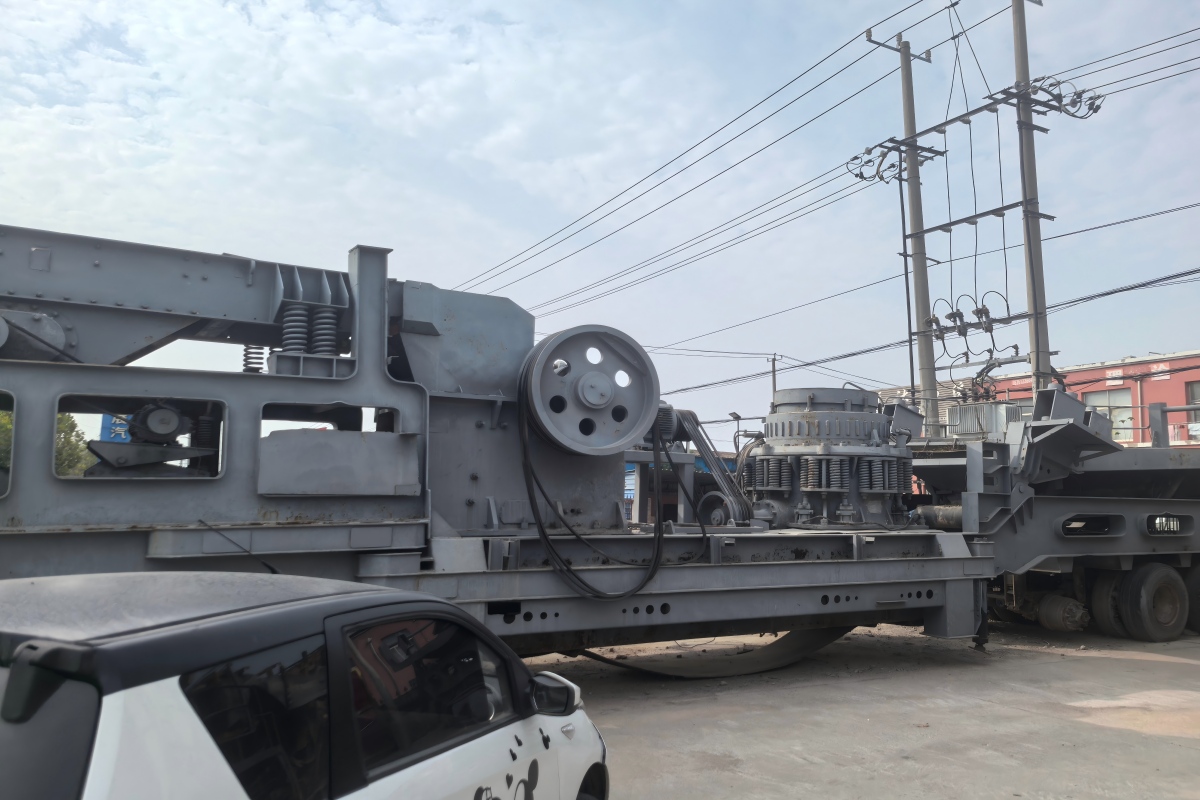
[100 TPH fixed crushing plant prepared for shipment to Nigeria – FairTradeMachinery.]
What did the Nigerian buyer order?
The confirmed order contains two equipment lines that work as one production chain rather than two separate purchases.
Table 1. Confirmed order lines
Equipment | Quantity | Configuration | Role on site |
|---|---|---|---|
8 units | Small class, used condition, inspected before shipment | Feed the crusher hopper, move stockpiles, load out trucks | |
1 unit | Stationary line, rated 100 TPH | Primary and secondary reduction, screened aggregate output |
One detail in the quantities is worth reading carefully. A single 100 TPH line is normally fed comfortably by one 3 to 5 tonne loader, with a second unit on standby. Eight units therefore point to a fleet spread across several sites, or to a buyer restocking rather than equipping one quarry. FairTradeMachinery did not disclose how the eight units will be deployed, and the order value was not published.
What is confirmed is the pairing logic: loaders and crusher bought together means one shipping programme, one spare-parts list and one commissioning schedule instead of three. On a fleet order of this size, that consolidation usually moves the landed cost more than the unit price does.
Why FairTradeMachinery instead of another supplier
Mr. Omar had already been sourcing in China before this order. In his account of the visit, the deciding factor was not the lowest quoted price, but how many options he could actually compare and whether the after-sales promises survived being written down.
“I have contacted many suppliers in China, but none of them could offer me as many alternatives and comparisons as FairTradeMachinery. You not only provide a wide range of equipment for customers to choose from, but you also back it up with real after-sales service guarantees.”
— Mr. Omar, buyer, Nigeria, October 2026
That sentence describes a sourcing model rather than a product. Most Chinese used-equipment sellers quote one machine per request: you ask for a small wheel loader, you receive one unit and one price. FairTradeMachinery works the other way round, presenting several comparable units in the same category so the buyer can weigh year, hours, brand and condition against each other before committing. The same structure applies across its inventory of more than 10,000 used units and 15 brands, which is why a buyer can move from a mobile to a fixed crushing configuration without changing supplier.
For buyers running the same comparison, the two starting points are the used wheel loader inventory and the used crusher inventory; both are updated daily, and well-maintained units commonly sell within 48 hours of listing.
What the after-sales package actually covers
Three deliverables were committed in writing before the deposit was paid. They are specific enough to be checked against, which is the point — “good after-sales service” cannot be enforced, a named deliverable can.
- Installation and commissioning guidance, remote. After the plant lands in Nigeria, FairTradeMachinery provides technical guidance for foundation and anchor points, conveyor and screen alignment, and the commissioning sequence, plus operator handover. What it does not include is on-site labour or civil works — those stay with the buyer.
- Spare parts shipped from China. If equipment fails, required parts are dispatched from China to Nigeria, air freight for stopping faults and sea freight for scheduled replenishment. For a crushing line the parts that matter are jaw plates, screen mesh, conveyor belts, and hydraulic hoses and filters on the loaders.
- Referral to Chinese engineers based in Nigeria. FairTradeMachinery introduces the buyer to Chinese mechanical engineers already working in Nigeria for on-site repair and maintenance. This is the item most Chinese suppliers leave out, and it is the one that decides how many days a stopped plant stays stopped.
The baseline warranty across all purchases is one year on core components, with no additional fee — the 1-year core-component warranty covers engine, hydraulic pump and swing motor on machines bought through the platform.
Mobile vs fixed plant: why he switched
The buyer arrived intending to purchase a mobile crushing plant. After reviewing the inventory and matching available configurations to his project requirements, he changed the order to a stationary 100 TPH line. The comparison behind that decision is the most reusable part of this case.
Table 2. Mobile vs fixed crushing plant at the same 100 TPH capacity
Criterion | Mobile crushing plant | Fixed crushing plant |
|---|---|---|
Mobility | Relocates between sites on its own chassis or low-bed | Installed once on foundations |
Setup time | Hours to a few days per move | Two to four weeks including civil works |
Capital cost per TPH | Higher — the chassis and running gear are part of the price | Lower for the same rated output |
Cost per tonne produced | Higher on a single long-term site | Lowest, once the plant runs continuously |
Output consistency | Affected by frequent re-levelling and re-calibration | Stable gradation after one commissioning |
Stockpile layout | Constrained by the trailer footprint | Conveyors can be laid out around the site |
Spare parts | Model-specific, more hydraulic and electrical complexity | Standard crusher wear parts, easier to source |
Best for | Road contracts that relocate every few months, short-term quarrying | A quarry or yard that stays put for years |
The rule of thumb used on most aggregate projects: if the plant stays on one site for more than 12 to 18 months, a fixed line pays back its installation cost and then produces at a lower cost per tonne; if the plant has to follow a road contract, mobile wins on downtime alone. Mr. Omar’s requirement fell on the fixed side of that line.
Buyers weighing the same choice can compare current configurations in the used crusher listings, where both mobile crushing plants and stationary jaw, cone and impact lines are held side by side. For the crushing-stage logic itself, the 2026 jaw crusher buying guide explains which primary unit suits which feed size and rock hardness.
What a 100 TPH fixed plant is made of
A 100 TPH fixed crushing plant is a stationary aggregate processing line rated to crush 100 tonnes of rock per hour. Unlike a mobile unit, every stage sits on its own foundation and the conveyors are laid out to suit the site, which is why the same 100 TPH rating can be delivered by quite different equipment combinations.
Table 3. Typical stage configuration of a 100 TPH stationary line
Stage | Equipment | Typical unit class | Function |
|---|---|---|---|
Feeding | Hopper + vibrating feeder | GZD-series grizzly feeder | Metered feed, scalping fines before the primary |
Primary | Jaw crusher | PE-600×900 or PE-750×1060 | Reduce run-of-mine rock to roughly 80–150 mm |
Secondary | Impact or cone crusher | PF-1214 impact, or spring/hydraulic cone | Reduce to 0–40 mm for screening |
Screening | Multi-deck circular screen | 3YK or 4YK, 1860 deck size | Split into 0–5, 5–10, 10–20 and 20–31.5 mm |
Conveying | Belt conveyors | 500–800 mm belt width | Transfer between stages and to stockpiles |
Control | MCC panel | — | Interlock, overload protection, sequential start |
Two engineering notes matter when reading a 100 TPH rating. First, capacity is normally quoted on limestone-class rock at around 1.6 t/m³; hard basalt or granite can cut effective output by 20–30% and usually calls for a cone rather than an impactor in the secondary stage. Second, the primary jaw sets the ceiling for the whole line — a PE-600×900 comfortably supports 100 TPH on medium-hard rock, while a PE-750×1060 leaves headroom for harder feed or later capacity growth.
Which loaders suit a 100 TPH line
Feeding a 100 TPH hopper is a cycle-time problem, not a size problem. A 3 to 5 tonne loader with a 1.7 to 3.0 m³ bucket completes a load-and-dump cycle in roughly 30 seconds, which leaves ample margin over the 100 TPH the plant can accept; the second unit exists to absorb breakdowns and shift changes rather than to add throughput. What actually breaks the cycle on a Nigerian site is dump height clearance over the hopper wall and hydraulic response in high ambient heat.
Table 4. Wheel loader classes commonly paired with a 100 TPH plant
Brand | Models typically in stock | Class | Best fit |
|---|---|---|---|
SDLG | L952, L953, L955 | 3–5 t | Budget fleet expansion; simple mechanicals, easy field repair |
LiuGong | CLG856H, CLG920, VL80A | 3–5 t | Stockyard and port duty, heavier structural build |
XCMG | LW600E, LW550HV, LW200 | 3–5 t | Road construction, general earthmoving around the plant |
Lonking | LG855, LG855H, ZL50NC, LG833 | 3–5 t | Mining and material handling, high-hour machines at lower cost |
For a fleet of eight, parts commonality is worth more than the specification sheet. Buying eight units across two models instead of four models halves the spares inventory the buyer has to carry in Nigeria, and makes the local engineer referral in the after-sales package far more useful, because the engineer is diagnosing the same machine twice a month rather than a different one every time. Current availability by brand is listed on the used wheel loader page, and multi-unit orders fall under the bulk discount programme — inland transport included for 2 to 4 machines, wholesale pricing and consolidated container packing from 5 units.
China to Nigeria: route and compliance
The loaders and the plant do not travel the same way, which is one reason a combined order needs to be planned as a single shipping programme.
- Inspection in China. Each unit is filmed with a video timeline — hour meter, cold start, swing, travel, each cylinder — and the serial number is matched to the contract.
- Contract and staged payment. Deposit on signing, balance against inspection video or bill of lading. The general sequence is set out in how to pay for second-hand equipment overseas.
- SONCAP Certificate of Conformity. Issued by a SON-approved body before the vessel departs; it cannot be obtained after arrival. Budget roughly USD 620–940 per unit. Requirements are set by the Standards Organisation of Nigeria.
- Booking. Loaders ship in 40 ft containers or on flat racks; a stationary crushing line moves as break-bulk or across several containers, with the jaw and screen frames braced separately.
- Sailing. Shanghai or Qingdao to Apapa, Tin Can Island or Onne, typically 30–40 days.
- Clearance and inland delivery. Form M and PAAR with Nigeria Customs, then a low-bed to site, 7–14 days for clearance plus 1–3 days on the road.
SONCAP is the step that goes wrong most often, and it fails before the goods move, not after. The full procedure, including documentation and HS classification, is covered in how to buy used equipment from China, and the Nigeria-specific compliance and site conditions are set out in the Nigeria roadwork equipment guide.
What this order says about 2026 supply
China exported 3,797 shipments of used wheel loaders between February 2023 and January 2024, a 268% increase on the preceding period. That supply depth is the reason a buyer can assemble eight comparable units and a crushing line in one sourcing trip instead of spreading the purchase across three suppliers and three shipping schedules.
On the demand side, Nigeria combines road construction, quarry-based aggregate production and a compliance gate — SONCAP — that removes the suppliers who cannot document a machine before shipment. The buyers who get burned in this market are rarely the ones who paid slightly more; they are the ones who paid in full before inspection, or accepted a unit whose serial number did not match the certificate. FairTradeMachinery now serves buyers in 50+ countries across Africa, Asia and the Middle East, and Nigeria sits inside the West African road and quarry segment that has grown fastest since 2024.
How the equipment was verified
Everything above rests on records rather than description. Before shipment, each of the eight loaders and the crushing line passed the same sequence:
- Video timeline of the actual unit, not a stock clip — hour meter, cold start, hydraulic cycle, travel and attachment movement.
- A ten-point inspection covering engine, hydraulic pump, swing, undercarriage, structural welds, hour-meter consistency, cooling and filtration, and serial number. The checklist is published as 10 steps to inspect used equipment before you buy.
- Serial number written into the contract and matched against the SONCAP application, so the machine that loads is the machine that was quoted.
- One-year core-component warranty on engine, hydraulic pump and swing motor.
Two comparable 2026 orders: a Pakistani buyer sourcing two Doosan excavators and an Ethiopian client securing two Sandvik drill rigs. Regional buying guidance for West and East Africa is in the blog library.
Frequently asked questions
The questions below are the ones buyers ask most often about this order and about the two equipment lines in it.
What did the Nigerian buyer order from FairTradeMachinery?
He ordered 8 used small wheel loaders and 1 fixed crushing plant with a rated capacity of 100 tonnes per hour. The two lines were ordered together as one production chain: loaders feed the crusher hopper and handle stockpile and truck loading.
Why did he choose FairTradeMachinery over other Chinese suppliers?
He gave two reasons. First, FairTradeMachinery offered more side-by-side equipment alternatives to compare than the other Chinese suppliers he contacted. Second, the after-sales package was put in writing before the deposit: remote installation guidance, spare parts shipped from China, and referral to Chinese engineers based in Nigeria.
Does FairTradeMachinery provide after-sales support in Nigeria?
Yes. For this order the support covers three deliverables: remote technical guidance for installation and commissioning after arrival, spare parts shipped from China if equipment fails, and introduction to Chinese mechanical engineers already based in Nigeria for on-site repair and maintenance.
Why did he switch from a mobile to a fixed crushing plant?
He originally came to buy a mobile crushing plant and changed to a stationary 100 TPH line after comparing available configurations against his project requirements. A fixed plant gives a lower cost per tonne and more stable output on a single long-term site; mobile units are preferable only when the plant has to relocate between sites.
What is a 100 TPH fixed crushing plant?
A 100 TPH fixed crushing plant is a stationary aggregate processing line rated to crush 100 tonnes of rock per hour. It normally comprises a feed hopper with vibrating feeder, a primary jaw crusher, a secondary impact or cone crusher, a multi-deck vibrating screen, belt conveyors and a control panel. Output is split into sizes such as 0–5 mm, 5–10 mm, 10–20 mm and 20–31.5 mm.
How much does a used small wheel loader cost from China in 2026?
Indicative FOB China pricing for used 3 to 5 tonne wheel loaders in working condition is roughly USD 12,000 to 35,000 per unit, depending on brand, year, working hours and bucket configuration. Fleet orders of 8 units are quoted as a package, with inland transport and container consolidation priced separately.
How long does shipping from China to Nigeria take?
Sea freight from Shanghai or Qingdao to Apapa, Tin Can Island or Onne typically takes 30 to 40 days. Customs clearance using Form M and PAAR adds about 7 to 14 days, and inland low-bed delivery to site takes 1 to 3 days depending on distance.
Is a SONCAP certificate required to import used machinery into Nigeria?
Yes. A SONCAP Certificate of Conformity must be issued by a SON-approved inspection body before the goods leave China. It cannot be obtained after arrival, and machines that land at Apapa without one face penalties, demurrage or re-export.
About FairTradeMachinery
FairTradeMachinery is a used construction machinery exporter based in China, connecting contractors, fleet buyers and dealers with inspected used equipment sourced directly from Chinese owners. Inventory covers used excavators, wheel loaders, cranes, crushers and drilling rigs, listing more than 10,000 units across 15 brands and serving buyers in 50+ countries. Every purchase includes a one-year warranty on core components and a documented pre-shipment inspection.
For a quotation on a similar configuration, send model, quantity and destination port through the contact page, or read the FAQs on payment, inspection and shipping.
Sam Hou · Senior Equipment Inspector
Sam Hou has inspected used construction equipment for export since 2013, covering engine, hydraulic and undercarriage assessment across excavators, loaders and crushing lines. He reviewed the inspection records and order documentation behind this article.
Cite this article
FairTradeMachinery. (2026, October 26). Nigerian Buyer Orders 8 Used Wheel Loaders and a 100 TPH Fixed Crushing Plant. Retrieved from /news/nigeria-8-used-wheel-loaders-100tph-fixed-crushing-plant.html
Sources
- Standards Organisation of Nigeria — SONCAP programme: son.gov.ng
- Nigeria Customs Service — Form M and PAAR procedures: customs.gov.ng
- Order documentation and pre-shipment inspection records, FairTradeMachinery, October 2026
- China used wheel loader export shipment data, February 2023 – January 2024, as published on the FairTradeMachinery wheel loader inventory page
Verification note: This article was compiled from the buyer’s order summary, the pre-shipment inspection records and the buyer’s own account given during the supplier visit. Commercial terms, order value and the buyer’s full name were not disclosed at the buyer’s request. Published 26 October 2026; last reviewed 26 October 2026
FairTradeMachinery
أنت تصمم الرؤية. نحن نتعامل مع الأجزاء الصعبة.
مساعدة المشترين العالميين على الوصول إلى آلات وحلول ما بعد البيع ذات قيمة أفضل.
بصفتنا منصة تبادل الآلات المستعملة الرائدة في الصين ، نحن نقع عند تقاطع تقنية إنترنت الأشياء والتجارة B2B. هذا يعني بيانات المخزون في الوقت الفعلي ، وملفات البائعين المعتمدين ، وعملية معاملات مصممة للمشترين عبر الحدود الذين لا يمكنهم دائمًا فحص الآلات شخصيًا. تجاوز مستخدمونا في الصين 1.5 مليون مما يعني أن لدينا المصدر الأول لأصحاب الحفارات والعدد المكافئ من الآلات. هذا يعني أننا يمكننا تغطية جميع الموديلات الشائعة وحتى الاحتياجات المحددة ، بغض النظر عن الحالة.






 دردشة مباشرة على واتساب الآن


 FAQs
 WhatsApp